

Unwanted calls are more than annoying. Some are harmless sales calls, but others may be tied to scams, robocalls, spoofed caller IDs, or phishing attempts. A spam phone number lookup helps you check an unfamiliar number before you answer again, call back, or share personal information.
Lookup results can show useful clues, such as possible caller details, public listings, spam reports, or patterns connected to unwanted calls. They are not guaranteed to be complete or current, but they can give you a safer starting point.
Table of Contents
What Is a Spam Phone Number Lookup?
A spam phone number lookup is a search process used to investigate an unknown or suspicious caller. Instead of guessing whether a number is safe, you search the number and review any available information connected to it.
Depending on the source and available data, a lookup may help identify:
- Whether the number has been reported as spam or suspicious
- A possible caller name, company, or organization
- General location or carrier-related details
- Public records or business listings connected to the number
- Patterns associated with robocalls, telemarketing, or scam activity
Important: Treat lookup results as clues, not proof. Phone numbers can be spoofed, recycled, mislabeled, or connected to old records. If the issue is financial, legal, or account-related, verify through an official channel.
Who Is Spam Calling Me?
If you are asking, “who is spam calling me?” the safest answer starts with verification. A number may look local, familiar, or professional on caller ID, but that does not always mean the call is legitimate.
Spam and scam callers often use tactics such as:
- Spoofing local area codes to look familiar
- Leaving vague voicemails that encourage a callback
- Claiming to represent a bank, delivery service, government office, or tech support team
- Using automated robocalls to find people who respond
- Calling repeatedly from numbers that look similar
If a caller claims to represent a real company, do not rely on the callback number in the voicemail. Visit the company’s official website or app and contact support from there.
How Can I Find Out If a Mobile Number Is Spam?
If you are wondering, “how can I find out if a mobile number is spam?” use more than one signal. A single search result may be helpful, but it is stronger when combined with call behavior, spam reports, and independent verification.
- Search the number: Use a phone lookup tool to check for available caller details.
- Review call behavior: Repeated calls, silent calls, and vague messages can be warning signs.
- Check spam indicators: Services such as Truecaller and Robokiller may provide additional spam or call-blocking context.
- Verify independently: If the caller claims to be from a known organization, contact that organization directly.
- Avoid sharing sensitive information: Do not provide passwords, one-time codes, payment details, or account recovery information to an unexpected caller.
Spam-blocking apps can be useful, but they should not replace careful judgment. A suspicious caller should still be treated cautiously, especially if they pressure you to act quickly.
How to Check a Suspicious Number
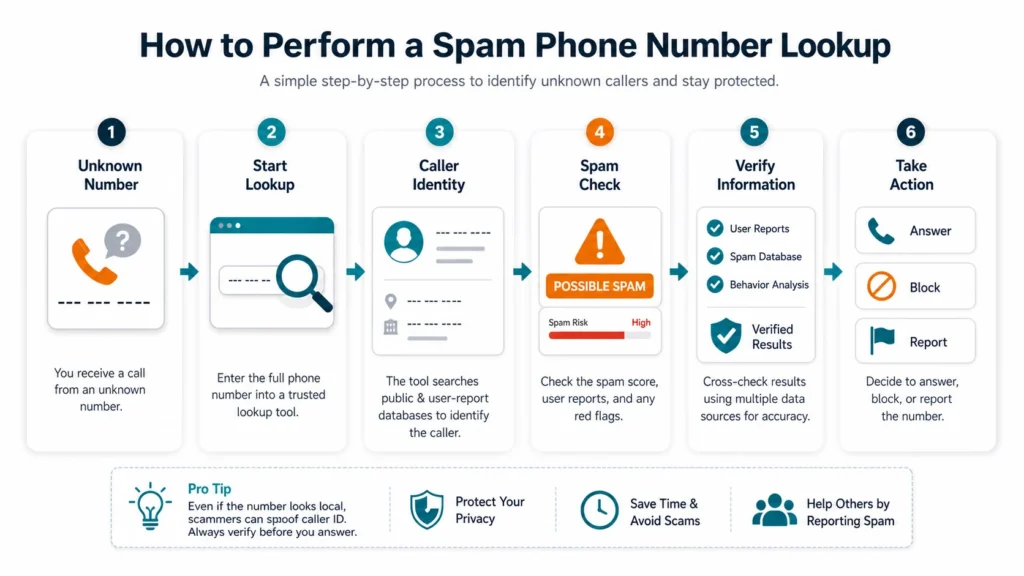
Checking a number only takes a few steps. The goal is to gather enough context to decide whether to answer, block, report, or verify through another channel.
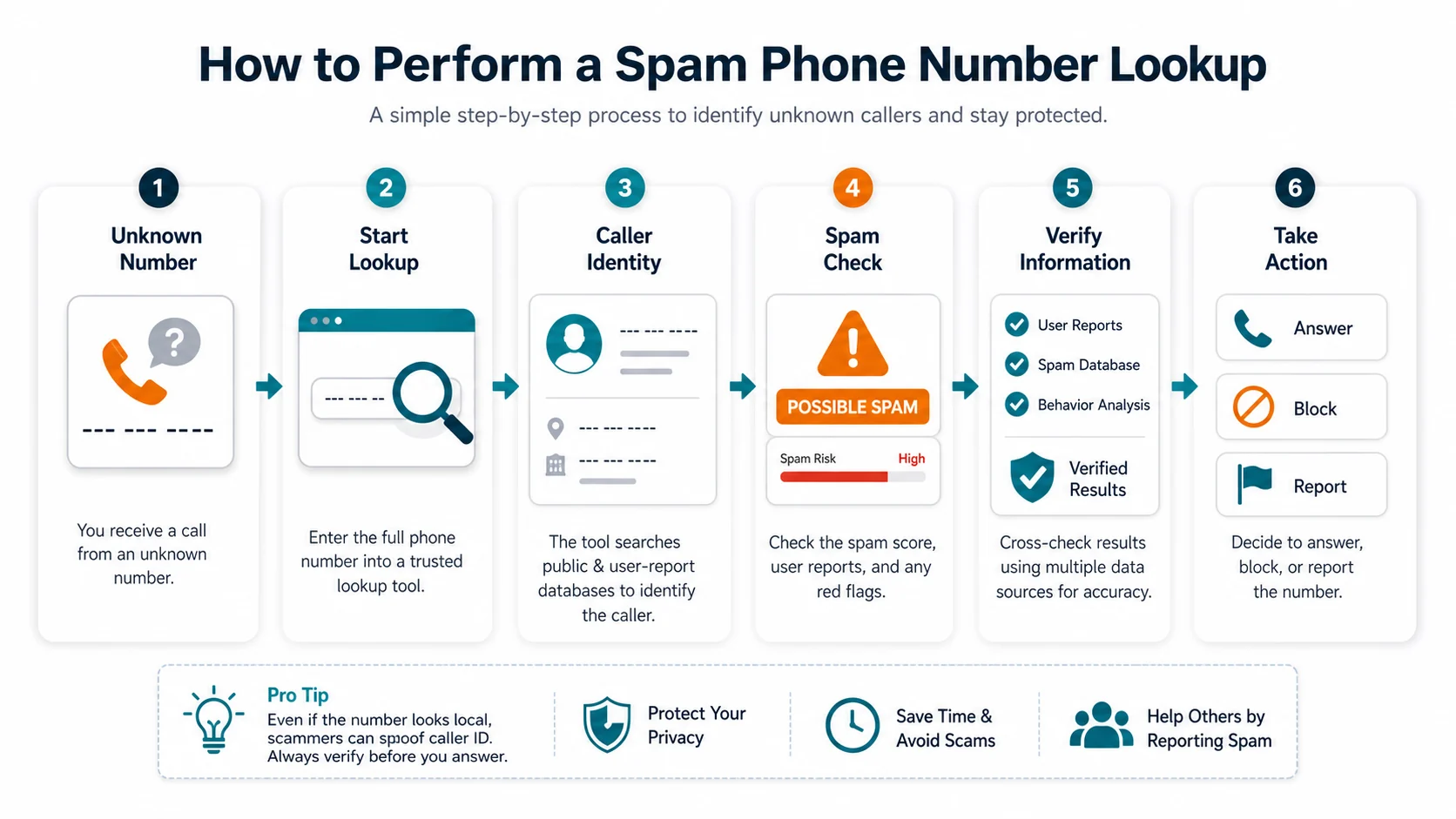
- Copy the full number. Include the area code and country code if available.
- Run a lookup. Search the number using a trusted phone lookup or spam-checking source. You can start with ReverseThatLookup’s phone lookup tool.
- Review the details. Look for caller identity clues, possible business associations, public records, or spam-related indicators.
- Compare sources. Check whether other spam detection services or community reports show similar concerns.
- Choose the safest next step. If the call looks suspicious, avoid calling back. Block, report, or verify through an official contact method.
Safety tip: Never share one-time passcodes, bank details, passwords, Social Security numbers, or account recovery codes with someone who calls unexpectedly.
Common Warning Signs of Spam Calls
Spam calls can vary, but many follow familiar patterns. Recognizing those patterns can help you avoid risky conversations.
Caller Behavior to Watch For
- The caller asks for sensitive information unexpectedly
- The message says you must act immediately
- The caller refuses to provide clear company details
- The number changes frequently but uses a similar area code
- The voicemail is vague and does not explain the purpose of the call
- The caller asks for payment through gift cards, wire transfers, cryptocurrency, or another unusual method
High-Risk Red Flags
- Threats of arrest, account closure, legal action, or service disconnection
- Requests for verification codes sent to your phone
- Claims that you won a prize or refund you did not request
- Caller ID that does not match the organization being claimed
- Pressure to stay on the line and not contact anyone else
The Federal Trade Commission offers guidance on how to stop unwanted calls, including robocalls and phone scams.
Is My Number on a Spam List?
If you are asking, “is my number on a spam list?” there are two different issues to consider.
First, your number may be receiving more unwanted calls because it appears in marketing databases, lead forms, old account records, public listings, data broker records, or breached contact lists.
Second, your number may be spoofed. Spoofing happens when a caller disguises their real number and makes another number appear on caller ID. If your number is spoofed, other people may receive suspicious calls that appear to come from you, even though you did not make them.
What You Can Do
- Use your phone’s built-in spam filtering features.
- Ask your mobile carrier about spam protection tools.
- Limit where you share your phone number online.
- Avoid answering suspicious calls just to ask them to stop.
- Register eligible numbers with the National Do Not Call Registry.
The Do Not Call Registry can reduce some legitimate sales calls, but it will not stop all robocalls, scams, or spoofed calls.
How to Block and Report Spam Calls
After identifying a suspicious caller, blocking and reporting the number can help reduce repeat interruptions and support broader spam detection efforts.
Block the Number on Your Phone
- On iPhone: Open Recents, tap the information icon next to the number, then choose Block Caller.
- On Android: Open Recents or Call History, tap the suspicious number, then choose Block or Report Spam.
- Through your carrier: Many mobile carriers offer spam filtering or call protection features in their apps.
Report Suspicious Calls
In the United States, you can report unwanted calls and scams to the FTC at ReportFraud.ftc.gov. The FCC also provides information about caller ID spoofing and unwanted calls.
Reporting does not guarantee that calls will stop immediately, especially if scammers rotate numbers. Still, reports can help carriers, regulators, and spam detection services recognize abusive calling patterns.
Frequently Asked Questions
Can a spam phone number lookup tell me exactly who called?
Sometimes, but not always. A lookup may show possible caller details, business associations, public records, or spam indicators. Because caller ID can be spoofed, results should be verified before you rely on them.
Should I call back an unknown number?
It is safer to check the number first. If the call claims to be from a bank, delivery company, government agency, or support team, contact the organization through an official website or app instead of calling back the unknown number.
Why do spam callers use local numbers?
Some spam callers use local-looking numbers to increase the chance that you will answer. This tactic can make the call appear familiar even when it is not legitimate.
What should I do if my number is being spoofed?
If people say they received calls from your number that you did not make, your number may have been spoofed. You usually cannot stop spoofing directly, but you can notify your carrier, avoid engaging with angry callbacks, and monitor your accounts for suspicious activity.
Can I remove my number from every spam list?
No single action removes your number from every database. However, you can reduce exposure by limiting where you share your number, using spam filters, registering with the Do Not Call Registry where appropriate, and avoiding suspicious forms or giveaways.
Is there a free spam phone number lookup?
Yes. A free spam phone number lookup can help you check whether an unknown caller has public reports, spam indicators, or suspicious call patterns. Free results may not show everything, so compare lookup details with caller behavior before deciding whether to answer, block, or report the number.
What is the difference between a spam call lookup and a phone number spam checker?
A spam call lookup usually reviews public clues connected to a number, while a phone number spam checker focuses on whether the number has been reported for scam, robocall, or telemarketing activity. Using both signals can give you a clearer risk picture before you respond.
Final Thoughts
A spam phone number lookup gives you a practical way to investigate unknown callers before you respond. It can help you spot suspicious patterns, avoid risky conversations, and decide whether to block, report, or verify a call through another channel.
The safest habit is simple: pause before responding, verify independently, avoid sharing sensitive information, and use blocking or reporting tools when a number appears suspicious.
Continue Your Search
Use ReverseThatLookup to review publicly available information connected to the details you already have.


